 Let's talk about your project ↗
TECHNICAL
Design decisions that reduce pressure loss inside the block.
Loss turns into heat; and heat is extra power drawn by the pump.
Every metre of passage, every bend and every restriction inside the block swallows a certain amount of pressure. The pressure swallowed turns into heat: the oil warms up, viscosity drops, and the pump draws more power to do the same work. Pressure loss is therefore not only a matter of efficiency but also a matter of cooling and service life.
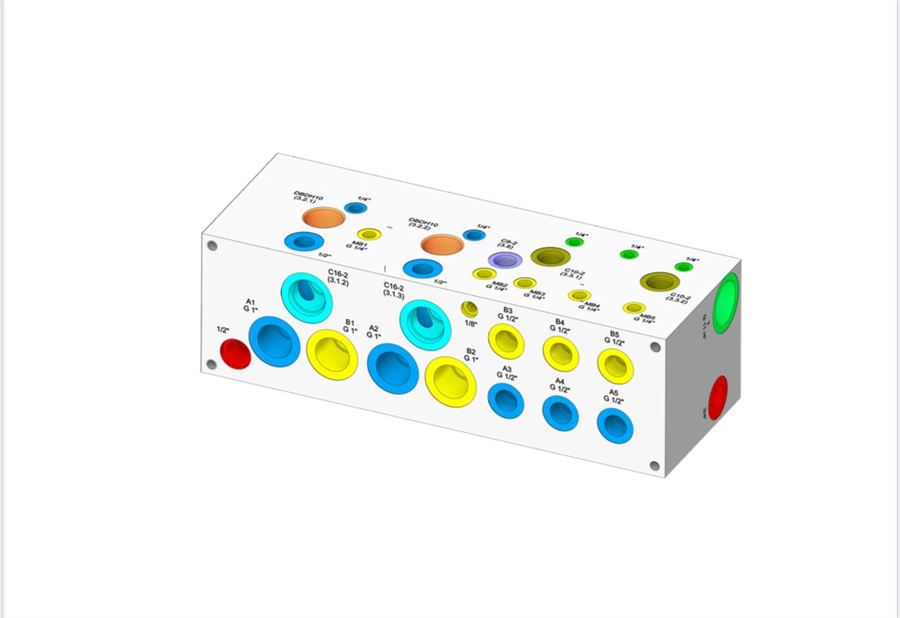
Passage diameter and pressure loss
The largest item of pressure loss is flow velocity, and velocity is inversely proportional to the passage cross-section. Enlarging the diameter a little lowers the loss noticeably. But every enlargement also enlarges the block; the decision is taken at the smallest diameter that keeps the loss within acceptable limits.
The pressure line, the return line and the pilot line do not have to be the same diameter. Velocity in the return line is generally kept lower, because the loss there is added directly to the tank pressure.
Intersection angle and sharp turns
Inside the block the flow travels through straight holes that intersect each other. Two passages meeting at a right angle force the fluid into a sharp turn, and a vortex forms there. If the same connection can be made at a wider angle, the loss drops visibly.
Sudden contractions and expansions
The transition from a large diameter passage into a small diameter port is a sudden contraction and creates pressure loss. When it cannot be avoided, stepping the transition helps. The same applies to the inlet mouths of the valve cavities.
Dead volumes and blind holes
Blind volumes the flow does not reach do not create loss directly; but they collect air and contamination. As the trapped air is compressed and expands, the response of the system becomes soft and positional accuracy deteriorates.
Surface and burrs
Roughness on the hole surface and burrs left at the intersections disturb the flow. A cleaned block is not only more reliable but also has less pressure loss.
Practical checks in the design
- Is the passage diameter sufficient on the line carrying the highest flow?
- Can the right angle intersections be turned into wider angles?
- Have the sudden diameter changes been stepped?
- Have the blind volumes been reduced?
- Is the return line easier than the pressure line?
All of these decisions are taken on the 3D model, before manufacturing starts. We describe the design process on our manifold engineering page.
Is your drawing ready?
Let us start together.
Share your hydraulic schematic or your technical drawing. Our engineering team will come back to you with technical feedback the same day.