 Let's talk about your project ↗
TECHNICAL
What is a hydraulic manifold block?
How it differs from conventional piping and in which applications it is preferred.
draft article — to be reviewed by the company before publication
What does a manifold block do?
A hydraulic manifold block is the part that gathers the valves, port connections and flow passages of a hydraulic circuit inside a single metal body. In a conventional installation the valves are connected one by one and linked to each other with hose or pipe; in a manifold block these connections are made by passages machined inside the block.
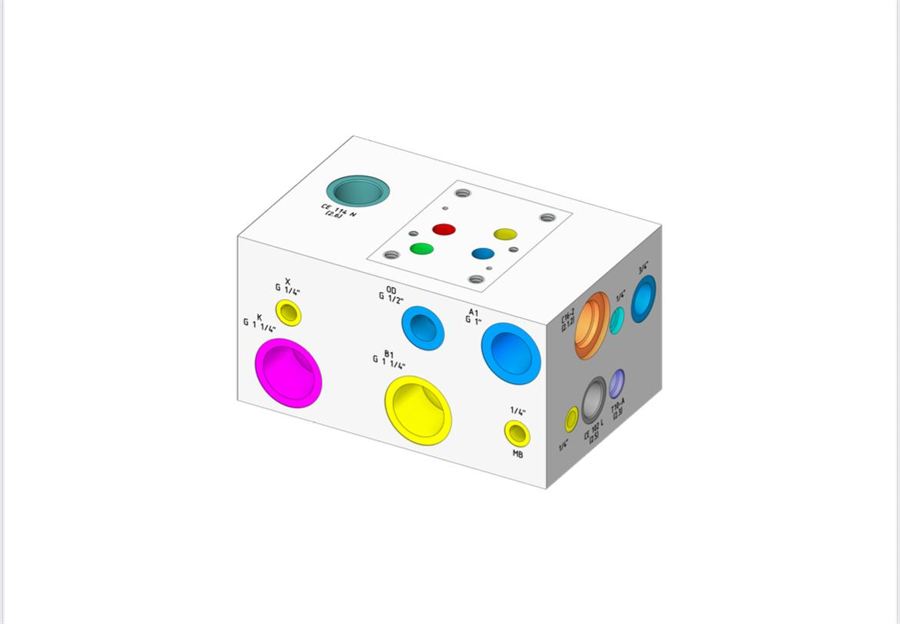
How it differs from piping
Fewer connections mean a lower risk of leakage. As the number of hoses and fittings drops, both the leak points and the fatigue points caused by vibration are reduced.
Passages inside the block follow a shorter and more controlled path than hoses. Because passage diameter, intersection angle and length are set at the design stage, pressure loss becomes predictable.
The system becomes physically smaller. In applications that have to fit into a tight space — lift control units are a good example — the manifold block is often the only workable solution.
Where is it preferred?
- In defence industry projects, where traceable and repeatable production is required
- In construction machinery, for control groups that must fit into a limited volume
- In concrete plant power units, under continuous operating conditions
- In lift control units, where a compact layout is mandatory
What is watched in block design?
Port layout is planned according to the assembly direction and maintenance access. Valve cavities are machined to the standard of the manufacturer of the valve to be used; that standard has to be settled at the start of the design.
Intersections of the internal passages, blind holes and dead volumes are eliminated at the design stage. These details affect both pressure loss and the venting of the air left in the system.
For more detail see the manifold engineering page, and you can request a quote for your own project.
Is your drawing ready?
Let us start together.
Share your hydraulic schematic or your technical drawing. Our engineering team will come back to you with technical feedback the same day.